
Bank of America isn’t backing away from its forecast for two more Federal Reserve rate hikes this year.
In addition, the Wall Street bank is raising a bigger question:
Will even 75 basis points of additional tightening be enough to bring inflation back to the Fed’s 2% target?
In a client note obtained by TheStreet, BofA’s response was a typical economistic “We’ll see,’’ adding:
“The hikes will look better in hindsight if:
- Equities and long-end rates rally.
- The economy holds up.
- Inflation moves back to target.”
BofA said it continues to call for two more quarter-point hikes in October and December.
“The robustness of the nominal economy both increases the risks of inflation persistence and reduces the risks that hikes will cause a recession. However, if supply shocks prove persistent, the Fed might eventually have to choose between an extended inflation overshoot and a hard landing,’’ BofA said.
BofA, market expected Fed September hike
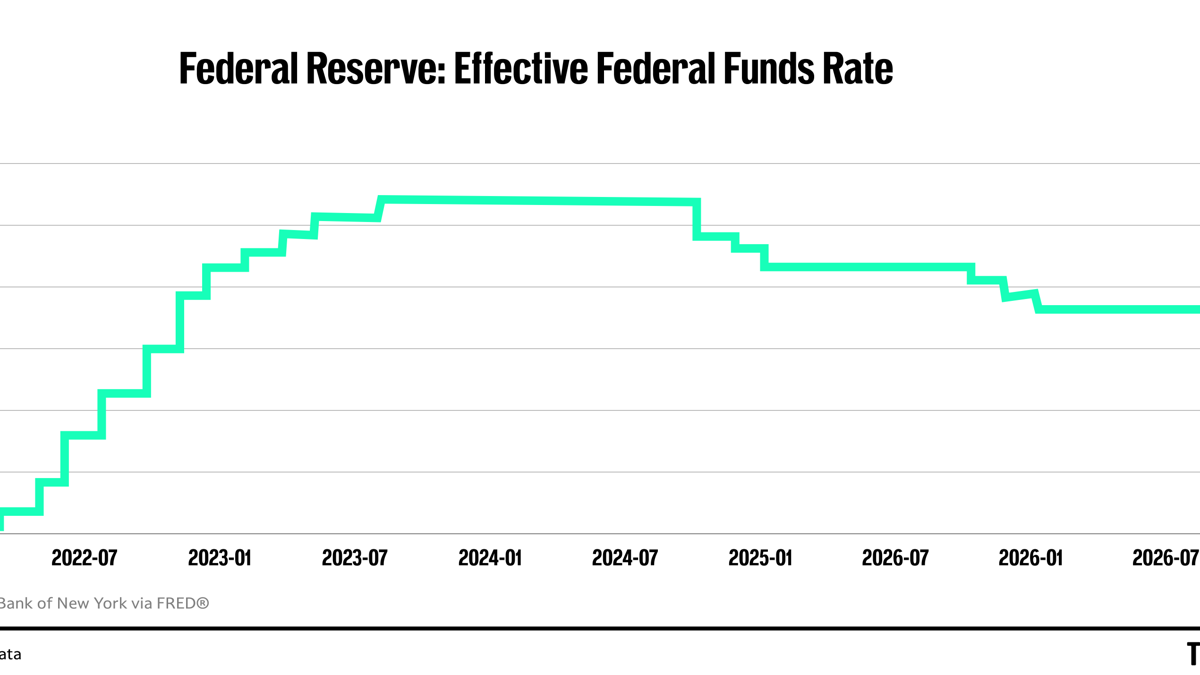
The unanimous 12-0 FOMC decision Sept. 16 of a 25 basis-point hike lifted the Fed’s benchmark Federal Funds Rate to a range of 3.75% to 4% and was widely expected by traders and Fed watchers.
It marked a renewed hawkish push to tighten monetary policy following persistent price pressures fueled, as I reported, by rising energy costs from the Iran War and related economic geopolitical shocks.
The big surprise: Fed policymakers signaled that another rate hike could be coming before the end of the year and potentially more if stubborn inflation from energy shocks and the Iran War geopolitical uncertainties don’t ease.
The rate hike was the result of months of public and private discussions by Fed policymakers who were trying to hold rates steady and at the same time allow inflation to return to its 2% goal — a target it has missed for 5.5 years.
The quarterly dot plot forecast, or Summary of Economic Projections, also released Sept. 16 showed showed a median year-end funds rate of 3.6%, consistent with one additional 25-basis-point hike from the current midpoint. Sixteen of 18 participating policymakers anticipate at least one additional rate increase before the end of the year.
“The statement dropped language linking inflation to supply shocks (I.e., no more excuses), while the SEP showed stronger growth, higher inflation and a lower u- rate despite two hikes this year,’’ the BofA note said.
BofA: The Fed is not making a policy mistake
BofA disagrees with dovish-leaning analysts who have argued that the Fed is making a policy mistake by raising rates.
“From Warsh’s monetarist perspective, the growth rate of the nominal economy is a function of the velocity of money and the money supply. The response to robust nominal growth is to slow the velocity of money by hiking rates,’’ the note said, adding the data support the case for reining in nominal growth.
Warsh lived up to his hawkish reputation
Fed Chairman Kevin Warsh had a reputation as an inflation hawk when he served as a Fed governor from 2006 to 2011. During a speech last month at Jackson Hole, he reaffirmed a commitment to taming inflation with a distinctly hawkish shift.
At the FOMC press conference, Warsh said:
“We cannot affect any individual price, whether it be oil prices, whether it be foodstuffs at the grocery store. But what we can do, and will do is ensure that any change in relative prices don’t broaden out. Don’t have second and third order effects in the economy.”
On Sept. 17, Warsh “reinforced the message, making it clear that the job is not done,’’ the BofA note said.
The Fed’s interest-rate hike, the first since January 2023, sent ripples through the entire financial system with the most immediate pressure hitting short-term borrowing such as variable-rate credit cards and student loans.
Related: Fed rate hike jolts markets after it signals a huge shock
Indirectly, it impacts fixed-rate mortgage rates which rely on Treasury yields plus corporate debt and capital investment.
The good news? Interest rates on savings accounts and CDs could see an increase.
BofA: Fed has opportunity to push inflation to target
Some Fed watchers argue the central bank didn’t need to hike in September because underlying inflation is already close to 2%, and the overshoot is almost entirely due to supply disruptions from tariffs and energy shocks that will roll off the year-over-year rate in short order.
BofA’s view is that underlying inflation has been stuck around 2.5% for several quarters because policy isn’t tight enough to push it back to 2%.
“We think the resilience of the economy changes the Fed’s risk/reward calculus,’’ the note said. “This seems to be a stroke of good fortune, and we think Warsh is doing the right thing by seizing the moment. On the other hand, robust nominal growth increases the risk that if the Fed doesn’t tighten, demand-driven inflation could pick up as the supply shocks fade.”
Will three hikes be enough?
The CME Group FedWatch Tool expects the likelihood of another quarter percentage point hike as 55.4% on Oct. 28 and the probability of at least one additional hike of 89.6% on Dec. 9.
BofA said there is a risk that the 75 basis point hikes in 2026 might not be enough to bring inflation back to the Fed’s 2% target.
One pernicious scenario: that supply-driven inflation might remain stubbornly high. For example, there might be a lot more inflation in the pipeline “due to the Iran conflict than we are accounting for in our base case.”
“This would leave the Fed with a difficult choice: either accept a few more years of above-target inflation, or put more pressure on aggregate demand than has been needed to hit the target in the past, risking a recession.
“Either choice would tarnish Warsh’s legacy. We’ll see.’’ the note concluded.
Related: Goldman Sachs drops surprise call for next Fed interest-rate hike