

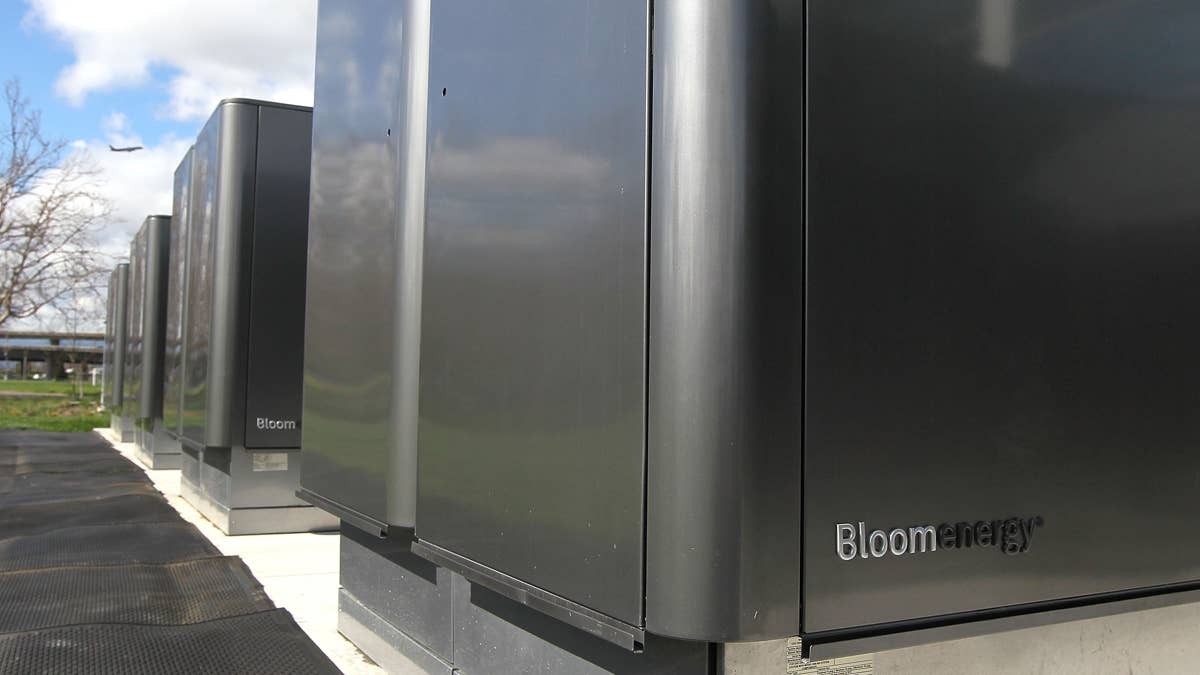
Bloom Energy (BE) makes solid oxide fuel cell systems that allow data centers to generate electricity on-site rather than waiting for a new connection to the power grid.
Its Energy Servers provide the constant electricity required by artificial intelligence data centers.
One of Bloom’s largest announced deployments recently encountered another obstacle.
A proposed natural-gas pipeline serving Oracle’s (ORCL) Project Jupiter in New Mexico faced a second regulatory rejection.
The campus is expected to use up to 2.45 gigawatts of Bloom fuel cells.
TheStreet previously reported that the pipeline setback could affect the project’s power schedule.
Bloom then reported record second-quarter revenue and raised its 2026 guidance.
Related: Bloom Energy’s $25B partnership targets AI’s next bottleneck
Bloom shares closed about 26.54% higher at $207.21 on July 30 following the report.
Morgan Stanley (MS) analyst David Arcaro maintained an Overweight rating and a $310 price target, according to a July 29 Morgan Stanley note shared with TheStreet.
The $310 target represented about 49.6% upside from Bloom’s July 30 closing price.
The bank’s argument centers on Bloom’s ability to redirect equipment to other sites and complete shipments under existing customer and financing agreements.
Morgan Stanley said those protections make Bloom less dependent on Project Jupiter remaining on its original schedule.
Bloom’s guidance makes an Oracle delay less dangerous
Bloom raised its full-year outlook for the second consecutive quarter after posting its first quarter with more than $1 billion in revenue.
The company’s second-quarter results included:
Key numbers from Bloom’s second quarter
- $1.07 billion: Revenue, up 166% from a year earlier.
- 34.3%: Non-GAAP gross margin, up from 28.2%.
- $226.4 million: Cash generated from operations, compared with $213.1 million used a year earlier.
- $3.9 billion to $4.2 billion: Bloom’s new full-year revenue guidance.
- $800 million to $900 million: Its new non-GAAP operating-income guidance.
Bloom generated $239.6 million in non-GAAP operating income.
The result exceeded the consensus estimate used by Morgan Stanley by 73%.
The midpoint of Bloom’s full-year revenue guidance increased by about $450 million.
Morgan Stanley estimated that the increase represents roughly 100 megawatts of additional shipments during the second half of 2026.
Bloom also raised the midpoint of its non-GAAP operating-income forecast by $175 million, or 26%, according to the note.
Management said no single project poses a risk to the revised 2026 guidance.
Morgan Stanley said Oracle could deploy fuel cells at other data-center sites if part of Project Jupiter moves into 2027.
Bloom’s relationship with Oracle already covers multiple project locations.
(Bloom) should be well insulated from individual project delays.
Some financing partners must also purchase Bloom equipment within a specified period after an order is signed.
Those terms could allow Bloom to record a shipment even when construction at the intended site falls behind schedule.
Morgan Stanley estimates Bloom’s backlog tops $8 billion
Morgan Stanley estimates that Bloom’s equipment backlog was at least $8 billion at the end of the second quarter.
The bank said the actual amount was probably higher because Bloom’s backlog has been growing faster than revenue.
Bloom did not formally report an $8 billion backlog.
The figure is Morgan Stanley’s estimate based on management’s comments about the pace of new orders.
That demand is not limited to Oracle.
Bloom said that all major U.S. hyperscalers, the largest cloud-computing companies, have validated and approved its power systems.
More than a dozen neoclouds, AI laboratories, and colocation data-center operators have also completed the process.
Validation means a customer has completed the technical review required to consider Bloom’s equipment for deployment.
It does not mean every company has signed a large purchase contract.
Bloom is reserving part of its manufacturing capacity for book-and-ship customers that need fuel cells on a shorter schedule.
The reserve allows Bloom to accept some orders without requiring the customer to wait for the full long-term backlog.
The arrangement supports Bloom’s time-to-power advantage because on-site generation can be installed faster than a new utility connection in some markets.
Management also suggested that customers may accept higher prices because getting electricity sooner allows them to begin using expensive computing equipment earlier.
Morgan Stanley described the comment as a potentially positive signal for Bloom’s pricing.
More Wall Street:
- Wall Street sends strong 4-word verdict on the stock market
- Wall Street’s $200 billion IPO wave threatens sell-off
- Wall Street flees software plays for triple-digit chipmaker boom
The bank is modeling positive operating cash flow and free cash flow for the rest of 2026.
Its deployment forecast remains at 1.8 gigawatts in 2027 and 4.8 gigawatts in 2028.
Scandium confidence came without new evidence
Bloom uses scandium oxide in the ceramic electrolyte inside its fuel cells.
The company says its diversified supply chain can support as much as 25 gigawatts of annual production.
Bloom also says it does not depend on China for scandium oxide and sources the material from several suppliers and countries.
Related: Overlooked AI stock is growing faster than Nvidia
Morgan Stanley said management remained confident that scandium availability would not limit Bloom’s growth.
The analysts also said the earnings call provided no new information about suppliers, procurement volumes or supply contracts.
Bloom still needs to make a bigger factory decision
The latest update, therefore, gave investors another assurance from management rather than new information they could independently assess.
Bloom provides more information about the material on its scandium supply page.
Morgan Stanley said Bloom’s current manufacturing capacity should be sufficient to meet its near-term backlog and growth forecast.
The bank’s model assumes deployments rise from 1.8 gigawatts in 2027 to 4.8 gigawatts in 2028.
Morgan Stanley is waiting for Bloom to commit to a new facility that would take annual manufacturing capacity beyond five gigawatts.
A larger factory would require additional capital and time before it could contribute finished systems.
Bloom must also convert its backlog into completed shipments without allowing customer construction and installation delays to move revenue into later years.
Morgan Stanley maintained a $310 base-case target and a $520 bull case.
Its $115 bear case assumes stronger competition, slower growth, and weaker progress in lowering manufacturing costs.
The bank identified two developments that could lead it to raise its forecasts: another major data-center customer and a formal commitment to expand manufacturing beyond five gigawatts.
Until either occurs, Morgan Stanley is keeping its deployment forecast at 1.8 gigawatts in 2027 and 4.8 gigawatts in 2028.
Related: This pre-IPO company is answering AI’s 8,000% energy demand